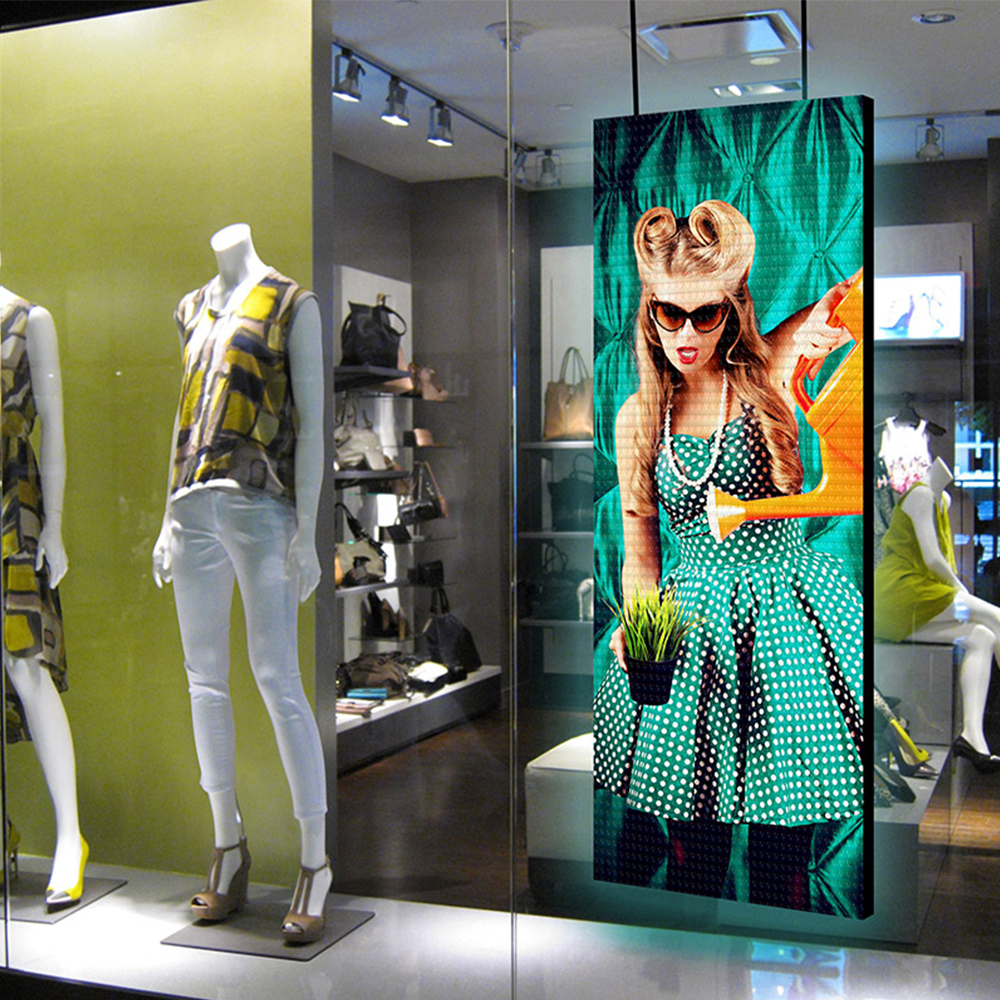
NewsSite EditorSite/uploads/image/68931a3c33409.png960x960mm aluminum LED cabinets and 480x320mm modules enable seamless round corner naked-eye 3D LED screens with precision, durability, and efficient maintenance for DOOH projects.
Mastering DOOH Engineering: Why 480x320mm Modules and 960x960mm Aluminum Cabinets Ready the Way for Naked-Eye 3D Round Corner Screens
Views: 341Author: Site EditorPublish Time: 2026-07-28Origin: Site
The Digital Out-of-Home (DOOH) advertising landscape is undergoing its most significant architectural shift in a decade. Static billboards have long been replaced by standard flat LED displays, but today, premium media owners and system integrators are demanding higher engagement metrics. The solution driving massive foot traffic and viral social media impressions globally is the Naked-Eye 3D outdoor screen.
However, engineering a flawless naked-eye 3D digital billboard requires precise hardware choices. Standard, legacy LED cabinets often fail to deliver the geometric accuracy needed to maintain three-dimensional optical illusions.
To bridge this gap, top-tier 960x960mm LED cabinet manufacturer designs have evolved. By pairing a high-precision 960x960mm aluminum LED cabinet with large-format 480x320mm LED modules, and utilizing a seamless round corner 3D LED screen structure, modern display networks can achieve a perfect blend of structural integrity, effortless maintenance, and breathtaking visual immersion.
In this technical whitepaper, we will dive deep into the engineering mechanics behind this hardware configuration and answer the two most critical questions faced by AV project managers today.
1. The Architectural Blueprint of the 960x960mm Aluminum Chassis
To understand why this specific hardware combination excels, we must first analyze the structural foundation: the 960x960mm die-cast aluminum LED cabinet.
Historically, outdoor fixed LED displays relied on heavy, welded iron sheet cabinets. These legacy structures suffered from thermal expansion warping, poor rust resistance in coastal zones, and wide manufacturing tolerances (often exceeding 1mm to 2mm). In contrast, modern high-end commercial projects utilize high-pressure die-casting aluminum alloys.
By passing these aluminum frames through advanced CNC (Computer Numerical Control) milling, factories can guarantee structural tolerances of ≤ 0.05mm. This extreme micro-level planarity is the absolute prerequisite for both a front and rear service LED screen mechanism and a seamless curved corner naked-eye 3D billboard assembly.
2. Engineering Deep Dive—Why Choose a 480x320mm LED Module Instead of Traditional Smaller Modules?
When designing a commercial LED video wall cabinet, engineers must choose the physical footprint of the internal display building blocks. For years, smaller modules—such as 320x160mm, 250x250mm, or 192x192mm bricks—were the industry norm. However, scaling these small formats up to massive building facades introduces significant technical liabilities.
Upgrading to a 480x320mm large-format LED module changes the operational math completely. Here is the technical breakdown of why this large-size panel is vastly superior for premium integration.
2.1 Superior Mechanical Planarity and Seamless Matrix Assembly
Every time two independent LED modules meet inside a cabinet, a physical seam is created. If you fill a standard 960x960mm LED display panel with traditional 320x160mm modules, you require a chaotic grid of 18 separate modules.
The Small Module Risk: With 18 modules, there are dozens of horizontal and vertical intersecting lines. Even a microscopic alignment error of 0.1mm caused by physical wear or heat expansion will create visible grid shadows across the screen. For a naked-eye 3D screen, these grid lines fracture the forced-perspective illusion, immediately reminding the human eye that it is looking at a flat grid rather than a volumetric 3D space.
The 480x320mm Mathematical Sweet Spot: A 480x320mm large-size module divides a 960x960mm framework perfectly:
480 mm × 2 = 960 mm (Width)
320 mm × 3 = 960 mm (Height)
This results in a clean 6-module configuration per cabinet (2x3 matrix). By slashing the internal module count by up to 66%, you eliminate the majority of physical seams, creating an ultra-flat, mathematically unified, and seamless LED display surface.
2.2 Radical Reduction in Electronic Failure Points
In professional AV integration, the overwhelming majority of component failures do not stem from the LED diodes themselves; they occur at the internal interconnection interfaces. Ribbon cables can degrade, data hub pins can experience cold solder joints, and DC power terminals can loosen due to environmental vibrations (such as traffic rumble or wind loads on a skyscraper facade).
By transitioning from 18 small modules down to 6 480x320mm large-format LED modules, you automatically eliminate up to 70% of internal data cables and power links. Furthermore, this large footprint is engineered for hard-connection 960x960mm LED panel architectures. Instead of fragile ribbon wires, modules utilize robust board-to-board gold-plated pin connectors that plug directly into a centralized power/data backplane, drastically elevating long-term system stability.
2.3 Slashing On-Site Maintenance Labor Costs by 40%
For a outdoor LED poster owner, screen downtime directly equates to lost ad revenue. If a module requires servicing on a busy highway pillar or a high-rise retail facade, dispatching technicians with complex tools is both dangerous and expensive.
A 480x320mm magnetic outdoor LED module layout simplifies logistics through a true front and rear maintenance LED display design. Because each module covers a broader surface area, technicians can use a specialized vacuum suction tool from the front (or quick-release latches from the rear) to swap out an entire section of the screen in under 10 seconds. This "dual-service" agility ensures that wall-mounted setups without rear walkways can be serviced entirely from the front without dismantling the structural cabinet frame.
Smaller PCBs packed densely together act as localized heat traps, creating thermal hotspots behind the LEDs. Excessive heat accelerates pixel color shifting and diode degradation, causing uneven brightness across a billboard over time.
The aluminum-backed structure of a 480x320mm large-size LED module allows internal heat from the constant-current driving ICs to spread uniformly across a wider surface area. When mounted inside a high-conductivity die-cast aluminum frame, the entire cabinet transforms into a passive heatsink. This enables a fanless silent cooling aluminum LED cabinet configuration, eliminating noisy, high-maintenance mechanical fans while protecting the system against dust and water ingress.
3. Optical Engineering—How Does the 960x960mm Aluminum Cabinet Achieve a Seamless Round Corner for Naked-Eye 3D Effects?
The jaw-dropping realism of a naked-eye 3D digital billboard relies on a neurological phenomenon known as forced perspective. By displaying content from a specific, mathematically calculated viewing angle, creators can convince the human brain that objects are floating out of the screen boundaries.
However, if the content has to pass over a harsh, sharp 90-degree right-angle building corner, the physical corner edge creates a structural seam line. This line breaks the geometric perspective, instantly destroying the 3D illusion.
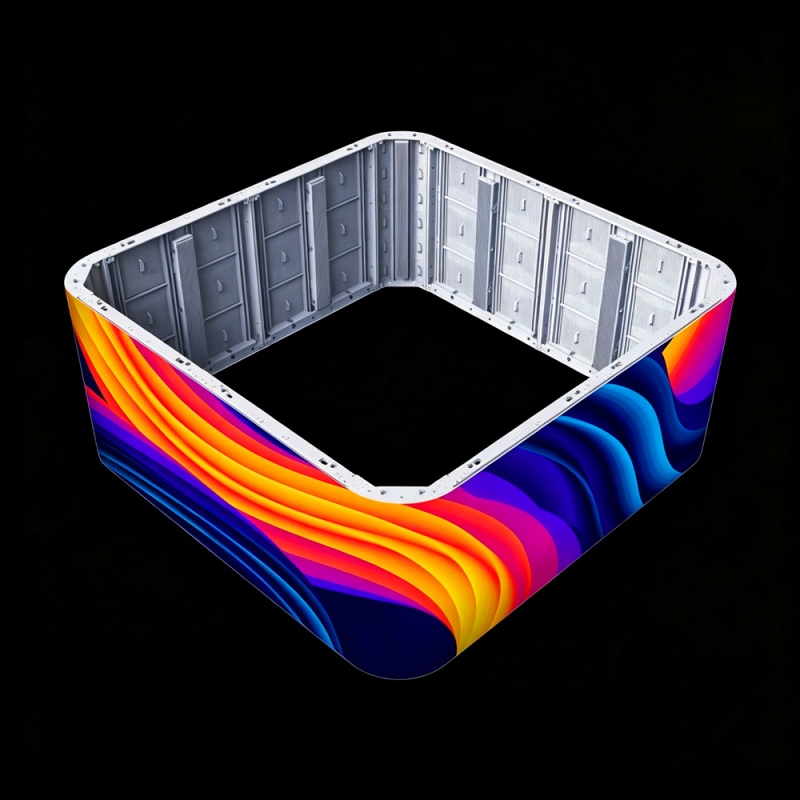
To solve this, specialized L-shape corner LED display 960x960 cabinet configurations are engineered to create a perfectly smooth, rounded transition. Here is the mechanical and optical process behind achieving this seamless round corner curve.
3.1 The 45-Degree Precision Miter Cut Cabinet Chassis
To build a seamless wrap-around corner screen on a building facade, engineers do not place two standard flat square boxes flush against each other. Instead, specialized transition cabinets are integrated into the 960x960mm aluminum cabinet layout.
The connecting side walls of these specific corner cabinets are precision-milled via CNC at a perfect 45-degree miter angle. When two of these mitered aluminum frames are locked together using industrial tension latches, they form a rigid, highly stable 90-degree right angle. Crucially, the exterior facing profile of this joined corner cabinet is not sharp; it is cast with a mathematically calculated, smooth radial curve (radius corner).
A standard fiberglass PCB is rigid and will crack if subjected to bending stress. To flawlessly skin the curved exterior profile of the corner cabinet, manufacturers deploy a specialized variant of the 480x320mm LED module:
Polyimide Flex PCBs: The circuit board substrate inside the corner module is swapped with an ultra-thin, highly resilient flexible polyimide or rubberized composite material.
Geometric Subdivision: The 480x320mm module footprint is structurally sub-divided into narrow, vertical pixel column strips. This allows the module to smoothly wrap around the cabinet's custom radius without straining the copper circuit traces or the solder pads of the individual SMD lamps.
High-Strength Neodymium Magnetic Matrix: The rear of the flexible module is packed with premium neodymium magnets that snap onto the precision-curved CNC-machined structural ribs of the aluminum cabinet. This guarantees the curve radius remains absolutely uniform across the entire height of the display tower.
3.3 Absolute Pixel-Pitch Continuity Across the Curve
For the human brain to perceive a continuous, unbroken three-dimensional field of view, the pixel density cannot fluctuate as a visual asset travels from Flat Wall A, around the rounded bend, and onto Flat Wall B.
Because the custom round corner cabinet is mathematically optimized to match the physical dimensions of the 480x320mm large-format LED module, the horizontal and vertical pixel pitch (P) remains completely constant throughout the transition (e.g., exactly P3.33, P4, or P5 across both flat and curved zones). There is zero pixel stretching, compressing, or distortion across the bend, providing a uniform pixel matrix that allowing 3D content rendering engines to map coordinates perfectly.
3.4 Hardware and Software Synchronization via High Refresh Architectures
A seamless round corner curve requires ultra-premium rendering hardware to eliminate optical artifacts. Naked-eye 3D content relies heavily on smooth gradient shading and volumetric shadows to simulate depth.
By utilizing a high refresh 3840Hz 3D LED screen driver configuration, the screen eliminates scan lines and screen flickering. When paired with an advanced industrial-grade controller network (such as a NovaStar controlled 960x960mm display system or an asynchronous Xixun 4G cloud media player), the software treats the flat walls and the rounded corner as one single, continuous digital canvas. The controller maps coordinates without layout lag, allowing a 3D asset (such as a breaking wave or a kinetic robot) to glide over the rounded building corner smoothly, maintaining a stunning, unbroken 3D depth illusion.
For professional AV consultants and weak-current engineers drafting project tenders, the table below demonstrates how the standard flat 960x960mm die-cast aluminum LED cabinet syncs perfectly with specialized curved corner transition modules to build a unified DOOH digital out-of-home LED screen network.
Technical Parameter
Standard Flat 960x960mm Cabinet
Seamless Round Corner 3D Cabinet
Cabinet Dimensions (WxH)
960 mm x 960 mm
960 mm x 960 mm (Adjusted Depth for Radius)
Cabinet Chassis Material
High-Precision Die-Cast Aluminum Alloy
CNC-Milled Aluminum with 45° Miter Joins
Module Dimensions (WxH)
480 mm x 320 mm Large Format
480 mm x 320 mm Flexible Geometric Format
Module Array Per Unit
2 Modules Wide x 3 Modules High
Customized Curve Wrapping Arrangement
Maintenance Access
100% Full Front & Rear Service Option
100% Full Front & Rear Service Option
Internal Cabling Structure
Pin-to-Pin Board Connection (Wireless)
Optimized Flexible Heavy-Duty Ribbon Looping
Refresh Rate Standard
≥3,840Hz (Broadcast Grade)
≥3,840Hz (Flicker-Free 3D Camera Ready)
Brightness Capability
Up to 6,500 - 8,000 nits (Outdoor High-Bright)
Up to 6,500 nits (Vivid Color Calibration)
Ingress Protection (IP)
Front IP65 / Rear IP54 Standard
Front IP65 / Rear IP54 Standard
5. Commercial ROI & Industry Deployment Guide
Investing in a 960x960mm dual-service aluminum display matrix equipped with seamless round corner 3D display capabilities provides deep commercial advantages for different sectors of the AV industry:
5.1 Landmark Building Owners & Real Estate Developers
Transform your building facade into an iconic landmark. A street intersection 3D LED billboard built with our 960x960mm aluminum cabinets commands premium advertising rates that are up to 300% higher than traditional flat screens. Because the system offers full front-access 480x320mm LED modules, you can mount the entire display flush against retail exterior walls without carving out costly maintenance walkways behind the screen.
5.2 DOOH Digital Out-of-Home Media Networks
Standardization is the key to scaling an advertising network rapidly. The 960x960mm dimension is a universally recognized standard sizing in global outdoor advertising. Media owners can easily design roadside billboards, digital totems, and massive plaza display walls using interchangeable inventory, drastically simplifying spare parts management and reducing ongoing maintenance overhead.
5.3 Sports Stadiums & Arenas
The ultra-lightweight profile of die-cast aluminum reduces the structural load-bearing requirements on stadium roofs and perimeter frameworks. Furthermore, the fanless silent cooling design guarantees that indoor arenas or perimeter court displays operate in total silence, avoiding any interference with referee communications or broadcast audio feeds.
Frequently Asked Questions (FAQ)
Q: Why is a 480x320mm LED module safer for automotive or high-vibration environments?
A: Traditional small modules rely heavily on long internal ribbon cables to daisy-chain data across the cabinet. In high-vibration areas—such as adjacent to subway lines, bridges, or highway overpasses—these cables can vibrate loose, causing signal dropouts. The 480x320mm LED module architecture is designed specifically for board-to-board hard connections, which mount directly onto a rigid aluminum backplane, eliminating loose wires entirely and ensuring continuous operational uptime.
Q: Can I update content on a round corner 3D LED screen remotely?
A: Absolutely. By pairing the cabinet hardware with advanced cloud architectures like an asynchronous Xixun controller inside taxi top style fleet hubs or a centralized NovaStar cloud CMS, you can upload, schedule, and monitor 3D video content over 4G LTE or WiFi networks. The system also supports real-time diagnostic reporting, alerting your technical team immediately if a power supply experiences an issue.
Q: Does a seamless round corner 3D screen require custom 3D video files?
A: Yes. To achieve the dramatic "pop-out" naked-eye 3D display effect, the video assets must be specifically rendered by an animator to match the exact resolution, curve radius, and optimal viewing distance of your specific corner location. However, when you are not running 3D campaigns, the screen functions perfectly as a standard digital billboard to stream regular 2D commercials across its entire surface without any software distortion.
Q: How does the anti-corrosion capability of aluminum hold up in coastal regions?
A: High-grade die-cast aluminum possesses natural oxidation resistance that far exceeds traditional cold-rolled iron sheet steel. For extreme installations—such as seaside boardwalks or cruise terminal facades—our factory applies an anti-corrosion marine-grade aluminum powder coating paired with conformal PCB treatments, protecting the 480x320mm LED modules from salt-spray damage and structural rust.
Conclusion: Build the Future of Visual Marketing
Maximizing your digital advertising footprint requires a balance between cutting-edge visual experiences and structural engineering efficiency. The integration of a 960x960mm aluminum LED cabinet with oversized 480x320mm LED modules represents the modern gold standard for high-performance displays.
By eliminating cabinet seams, reducing internal electronic failure points, and enabling complete front/rear service agility, this configuration ensures an incredibly low total cost of ownership. When combined with a custom engineered seamless round corner 3D display curve, it gives media owners and AV integrators the exact physical canvas needed to host legendary, high-revenue naked-eye 3D digital billboard networks.
Are you ready to elevate your architectural landscape and secure a high-ROI digital asset? Contact our engineering team today to request a factory-direct technical quote on our premium die-cast aluminum LED display 960x960 series and customizable 3D corner systems!